I didn't plan to become a leatherworker.
In 2022, I walked into PBloch — a family-run leather wholesaler that had been in town for over 20 years — looking for a strop to maintain my woodworking chisels. I didn't even know what a strop was called at the time. I just knew my edges needed help.
That same shop offered a free workshop on Friday mornings. It took me weeks to work up the courage to walk through the door. I'm not shy, but something about walking into a room of people who already knew what they were doing made me hesitate.
When I finally went, I was hooked within the first hour.
Not because it was easy — it wasn't. But because I saw how leatherwork connected to everything I already loved: woodwork, precision, patience, and the satisfaction of turning raw material into something useful and beautiful. The same skills that taught me to read grain in timber taught me to read hide. The same hands that cut dovetails learned to saddle stitch.
From hand tools to a home workshop
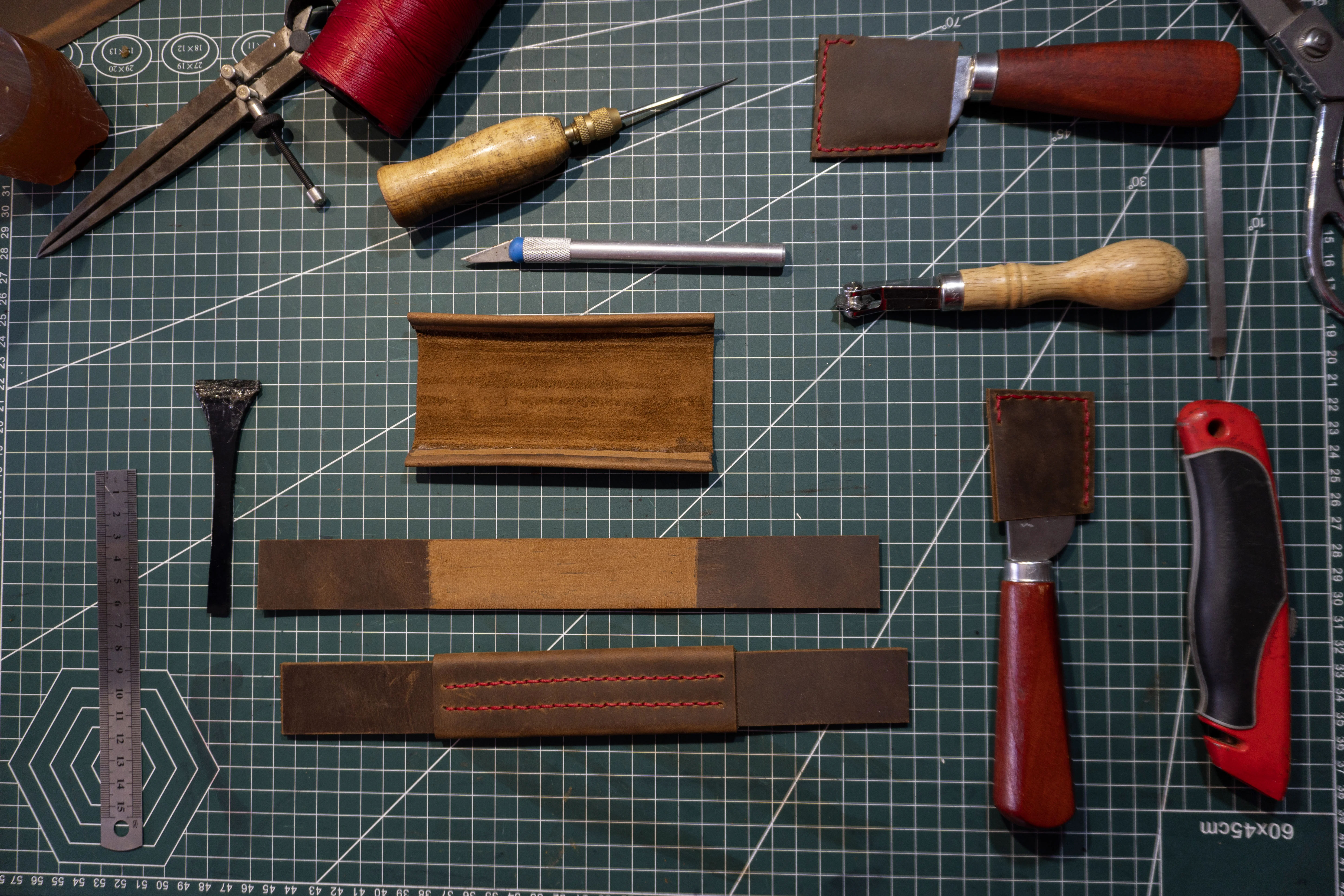
Over the next few weeks, I bought my first hand tools. Then more. Then better ones. And somewhere along the way, I realised that leatherwork wasn't just a side project — it was the thing that quieted my mind.
I spend my days surrounded by screens, notifications, and digital noise. But when I'm cutting leather, pulling thread, or burnishing an edge, I forget my phone exists. I don't check emails. I don't think about deadlines. I just work with my hands, one stitch at a time.
Today, my workshop has grown. The tools have multiplied. The skills have deepened. But the approach hasn't changed: cut by hand, stitch by hand, finish by hand. No machines. No shortcuts.
The materials that matter
I work with full-grain leathers — vegetable-tanned and pull-up — because they age honestly. They mark, they patina, they tell the story of being carried. I use solid brass and stainless steel hardware because it won't let you down. Liners are either upholstery fabric or pig suede — both chosen for durability and feel.
And every vegetable-tanned piece is treated with a dye spray that offers water resistance while still letting the leather breathe. I don't use latex finishes or anything that locks moisture in. Dubbin? Not for our climate. It breaks down oils and accelerates drying. I've seen it happen.
Instead, I make my own care blend: mineral oil, beeswax, and a drop of essential oil for a clean scent. It comes in a tin with every vegetable-tanned piece.
The HBL mark — and why you won't see it on your bag
Every piece I finish gets stamped with my HBL mark — Handcrafted By Luke. But here's the thing: you won't find that mark on the main product.
I've never liked the idea of a maker's brand being visible on something you carry every day. It feels like a billboard, and it's not why people buy handmade. Instead, I include a small key fob — made from the same leather as your piece — stamped with the HBL mark. It carries the provenance without getting in the way of the object itself.
If you want your own initials or name tooled into your piece, we can do that as part of a commission.
Why I still do this
I still use hand tools for almost everything. And I still get the same feeling I did on that first Friday morning — like I've stumbled into something that was waiting for me all along.
This isn't a side hustle. It's not a content strategy. It's just the work I want to do — one piece at a time, one stitch at a time, with my hands and my bench and the quiet focus that comes when the phone is face-down and the thread is pulling through the leather.
Every piece that leaves my workshop carries that. Not as a slogan. Just as the way it was made.
— Luke