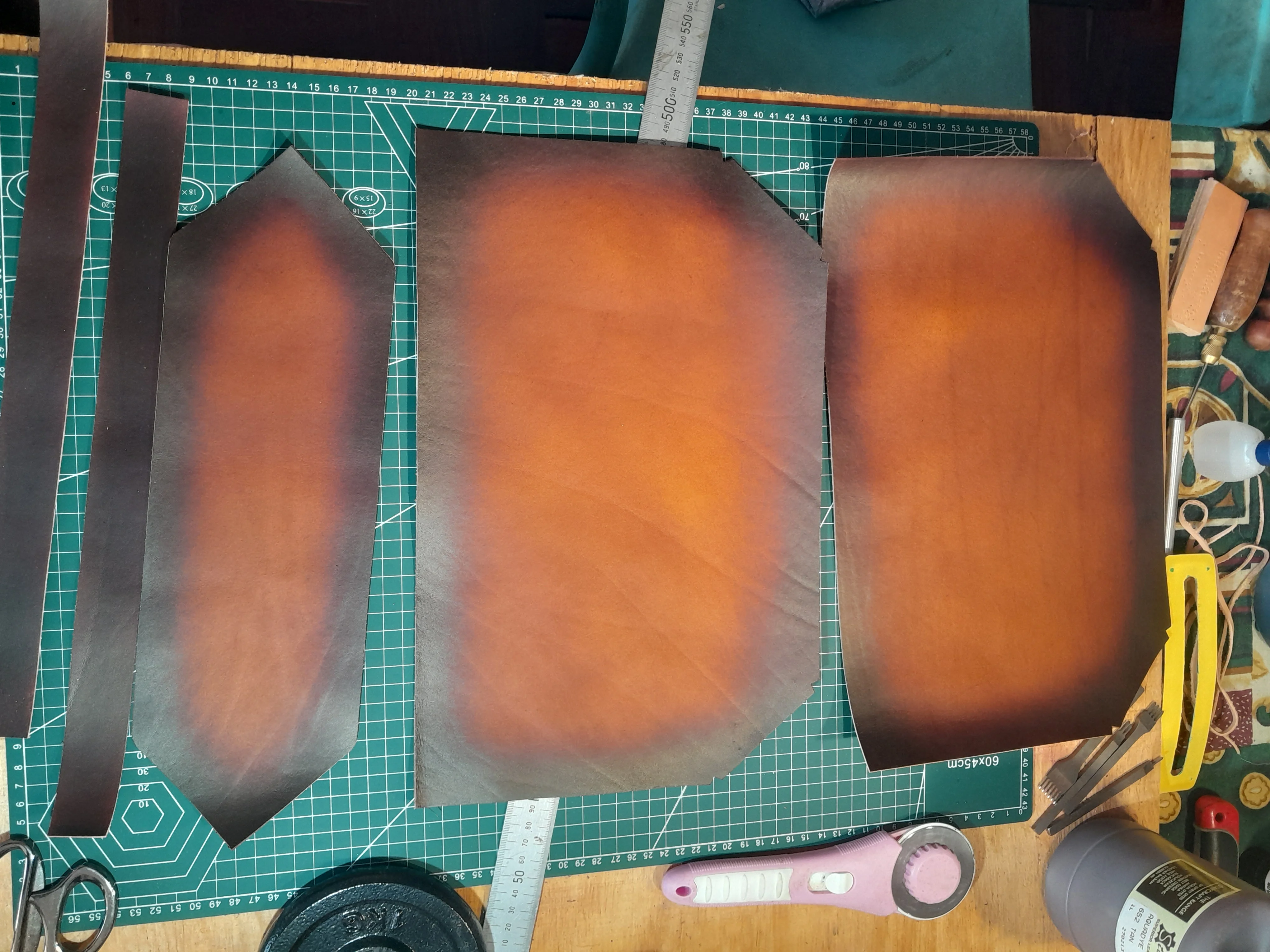
The Country Morning tote is one of those pieces that looks simple until you see it up close. Then you start noticing the colour transition, the depth, the way the leather catches light differently across the panels.
That doesn't happen by accident.
Dyeing — panel by panel
I dye each panel separately. There's no shortcut here — no dipping the whole piece and hoping for consistency. Each panel gets individual attention because each piece of leather responds differently to dye. That's the nature of vegetable-tanned leather.
The process:
Tan base — I start with a rich tan dye, airbrushed evenly across the full panel. This gives the leather its warm foundation.
Burgundy edges — Once the tan is dry, I airbrush burgundy around the edges, fading it inward. This creates that gradient effect you see on the finished tote — the deep, rich edges that transition into a warmer, lighter centre. The fade is controlled by hand, so no two panels ever come out exactly the same.
Clear waterproofing dye — This is the step most people don't see. I airbrush a clear dye that acts as a waterproofing layer. It doesn't change the colour. It doesn't add a glossy coat. It simply seals the dye in place while allowing the leather to keep breathing. No latex. No plastic feel. Just leather that can handle a bit of weather without trapping moisture inside.
My own finish — Finally, I apply the finish I make myself. The same blend of mineral oil and beeswax that goes into the care tins, applied by hand, buffed in, and left to settle. It adds a subtle sheen, a light scent, and a layer of protection that builds over time.
Stitching — by hand, of course
Once the panels are dyed and finished, they're stitched together using the traditional saddle stitch. Two needles. One thread. Each hole tied and pulled individually.
The stitching does more than hold the bag together — it frames the colour work. The contrast between the thread and the dyed leather is part of the design, not an afterthought.
Why this process matters
I could dye a whole bag in one go. It would be faster. It would be cheaper. It would also look flat.
By dyeing each panel separately, I get control over the fade, the intensity, and the transition from tan to burgundy. By using a clear waterproofing dye instead of a heavy sealant, I preserve the feel and breathability of the leather. And by finishing it with my own blend, I'm giving you something that's ready to use from day one — not something that needs to be conditioned before it can go out the door.
The result
A bag that looks dyed, not painted. A bag that shows the grain, the texture, and the hand of the maker. A bag that will patina with use and age the way vegetable-tanned leather is meant to.
Every Country Morning tote takes time. But that time shows up in the final piece — in the edge transitions, in the stitch lines, in the way the leather feels when you pick it up.
If you're reading this and thinking about ordering one, know that yours will be made the same way: panel by panel, stitch by stitch, by hand, from start to finish.